Google's new Flash models chase the same goal: cheaper, faster AI agents
Gemini 3.6 Flash, 3.5 Flash-Lite, and a security-only 3.5 Flash Cyber all aim at running AI agents at scale — for less money, with fewer wasted words.
The 60-second version
Google launched three new Gemini Flash models — 3.6 Flash, 3.5 Flash-Lite, and a security-only 3.5 Flash Cyber — all tuned to run AI agents cheaply and fast, with efficiency (fewer tokens per task) as the pitch.
Key points
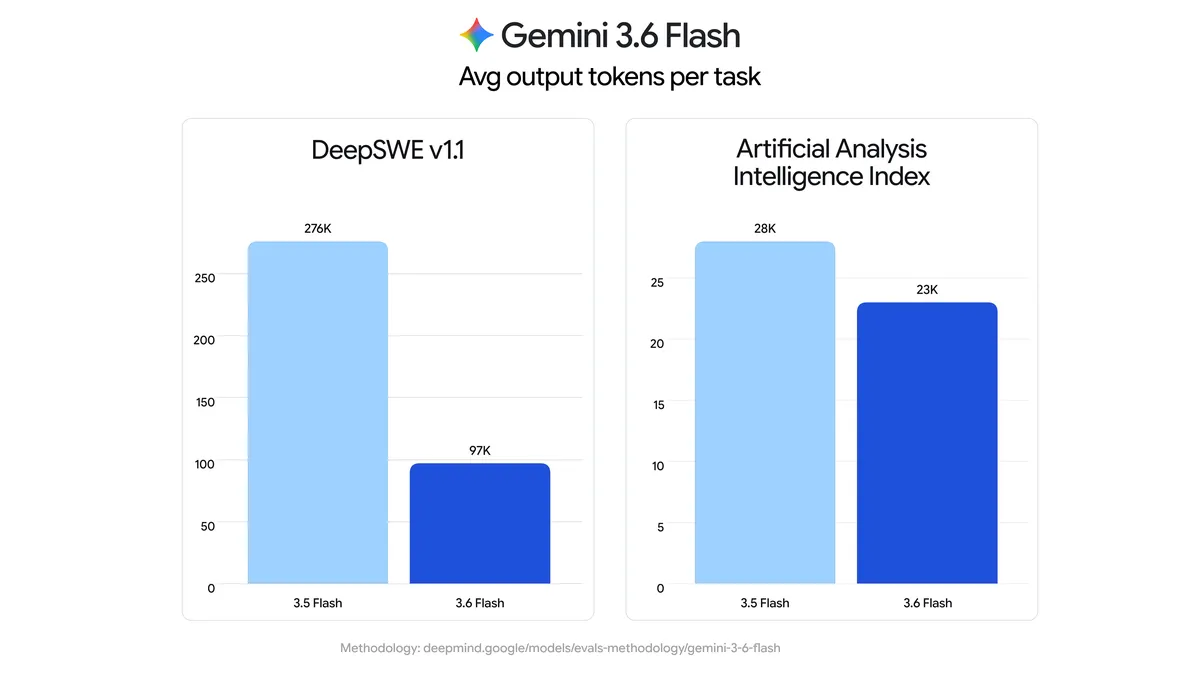
- 3.6 Flash: the workhorse — Google claims ~17% fewer output tokens than 3.5 Flash, plus a price cut to $1.50/$7.50 per 1M tokens.
- 3.5 Flash-Lite: fastest and cheapest ($0.30 input), 350 tokens/sec; Google says it beats the older, bigger '3 Flash' on some agentic tests.
- 3.5 Flash Cyber: a dual-use vulnerability finder/fixer, held back to governments and trusted partners via the CodeMender pilot.
- 3.5 Pro is coming soon; pre-training on Gemini 4 has started.
Verdict. A clear bet that the agent era rewards cheap efficiency over raw size — but nearly all the numbers are Google's own, so treat them as promising claims, not proven results.
What shippedThree models, one obsession: efficiency
Google refreshed its cheap-and-fast Gemini Flash line with three new models, all pointed at the same target: running AI agents — systems that grind through multi-step tasks by calling tools and checking their own work — affordably and at scale. The common thread isn't a bigger brain; it's doing the same work with fewer tokens, which is the thing agents actually cost money on.
The lineup: 3.6 Flash, a stronger everyday workhorse; 3.5 Flash-Lite, an ultra-cheap speed model; and 3.5 Flash Cyber, a security-only variant locked behind a pilot program.
The workhorse3.6 Flash: same job, fewer words
The headline for 3.6 Flash isn't a benchmark — it's frugality. Google says it uses about 17% fewer output tokens than 3.5 Flash on the third-party Artificial Analysis Index (and up to 65% fewer on some coding tests), while taking fewer reasoning steps and tool calls to finish a task. It also got cheaper. Since agents pay per token, fewer tokens per task means real savings.
On quality, Google reports gains across the board versus 3.5 Flash — more precise coding, a large jump in machine-learning research tasks, and better computer use (the model driving a screen the way a person would), now a built-in tool in the Gemini API.
| Benchmark (3.6 vs 3.5 Flash) | Score |
|---|---|
| DeepSWE (coding) | 49% vs 37% |
| MLE Bench (ML research) | 63.9% vs 49.7% |
| OSWorld-Verified (computer use) | 83.0% vs 78.4% |
| GDPval-AA v2 (knowledge work) | 1421 vs 1349 |
The budget speedster3.5 Flash-Lite: cheap, fast, surprisingly strong
Flash-Lite is the fastest model in the 3.5 family — Google clocks it at 350 output tokens per second — and the cheapest, at $0.30 per 1M input tokens and $2.50 output. Its job is high-volume, low-latency work: agentic search, document processing, big pipelines. Developers can dial its 'thinking' up or down to trade speed for depth.
The eye-catching claim: on several agentic and coding tests, Google says Flash-Lite beats the older, larger '3 Flash' — e.g. SWE-Bench Pro (54.2% vs 49.6%) and OSWorld-Verified (74.0% vs 65.1%). Smaller and cheaper, but not necessarily weaker.
The locked door3.5 Flash Cyber: a security specialist, held back on purpose
The third model is different in kind. 3.5 Flash Cyber is a version of Flash fine-tuned purely to find and fix software vulnerabilities, running inside a system called CodeMender. The design twist: CodeMender runs several Flash Cyber agents together and merges their work into a single combined report. Google says it reaches competitive frontier performance on the CyberGym benchmark.
Why it mattersThe industry is pivoting from 'biggest' to 'cheapest that works'
Zoom out and the launch tells a bigger story: the race is shifting from *how smart can one giant model be* to *how cheaply can a good-enough model run millions of agent tasks*. Efficiency, not raw scale, is the new battleground — because agents multiply every token by thousands of steps.
For AI agents, the winning model isn't the smartest — it's the one that reaches the answer using the fewest tokens.
Google added that Gemini 3.5 Pro is testing with partners and coming soon, and — the real eyebrow-raiser — that pre-training has begun on Gemini 4.
Primary sourcesGoogle — 3.6 Flash, 3.5 Flash-Lite, and 3.5 Flash Cyber