The $0.98 Saily US Number Deal, Decoded
A paid-partnership X post combines referral credits, a Saily +1 number and BeeSIM hardware for mainland iPhones, but KYC, changing promotions and uneven verification support are material limits.
The 60-second version
A sponsored X guide claims a staged referral can reduce a Saily US +1 number bundle to $0.98 initially, with the number later renewing at $0.99 per month.
Key points
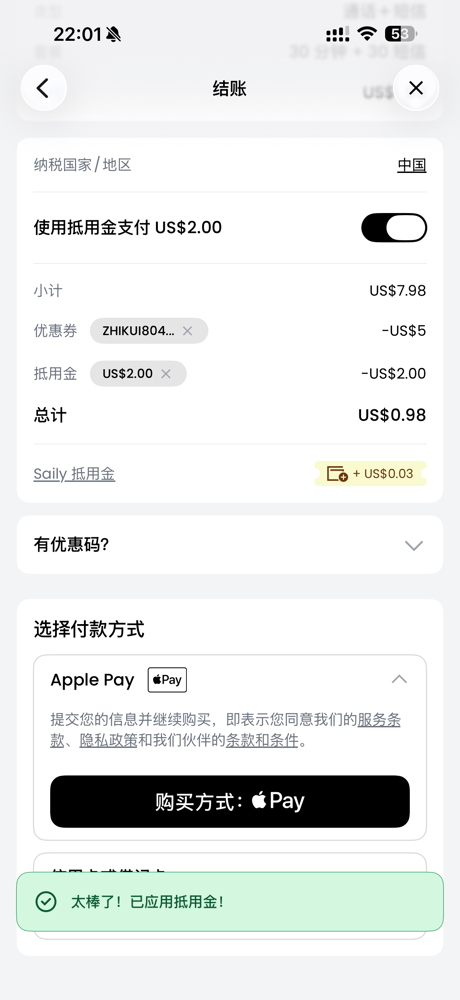
- $0.99 number + $6.99 China-region package − $5 referral − $2 new-user credits = the claimed $0.98 first payment.
- The referral is entered at a data-plan checkout that is abandoned before buying the number package.
- KYC is mandatory; the author's Chinese ID/passport result is not a guarantee for every applicant.
- BeeSIM can bridge eSIM to some mainland iPhones, but adds hardware, setup and compatibility risk.
- Giffgaff SMS, Telegram and WhatsApp reportedly worked; ChatGPT did not, and financial 2FA should be treated as unreliable.
Verdict. Potentially cheap for a noncritical secondary number, but the promotional sequence, KYC, affiliate incentives, device compatibility and service-by-service acceptance make it unsuitable as a universal verification solution.
The claimWhy the headline says $0.98
The post describes a Saily US +1 phone number costing $0.98 for the first month, then $0.99 per month for the number subscription. That first figure is not the list price of one standalone product: it is the result of combining a number, a regional communications package and two promotional deductions.
| Component | Claimed amount |
|---|---|
| US +1 number subscription | $0.99 |
| China-region 30-minute / 30-SMS package | $6.99 |
| Subtotal | $7.98 |
| Referral deduction | −$5.00 |
| New-user credits | −$2.00 |
| Claimed first payment | $0.98 |
Sequence mattersApply the referral, leave, then buy the number
The article's critical instruction is counterintuitive: begin checkout for a data plan, apply the referral code, and do not complete that purchase. Return to the store only after the referral has attached to the account, then buy the phone-number package. The claimed discount depends on this sequence.
- Create or sign in to the eligible new account.
- Open a data-plan checkout and apply the referral code.
- Exit without buying that data plan.
- Return and select the US-number offer and cited regional package.
- Inspect the final total, renewal price and cancellation controls before paying.
Identity checkThe number requires KYC
Obtaining the number requires identity verification. The author says a Chinese ID card or passport can pass, but that is an account-level report rather than a universal acceptance policy. Document quality, jurisdiction, account details and later compliance reviews can all affect the outcome.
Mainland iPhonesWhat BeeSIM is doing in the workflow
For mainland-market iPhones without native eSIM, the post promotes BeeSIM, a Bluetooth programmable nano-SIM. Its WeChat mini program or browser interface is used to scan an eSIM QR code, download that profile onto the card and enable it in the phone. BeeSIM is a hardware bridge; it does not make the number more acceptable to a verification platform.
- Install the BeeSIM nano-SIM in a compatible phone and open its mini program or browser interface.
- Scan the carrier's eSIM QR code and download the profile to the programmable card.
- Enable the profile and test connectivity before relying on it.
- Check the exact phone model, SIM-slot setup and operating-system compatibility first.

Actual testsOne received SMS does not mean every verification works
| Service or test | Result reported by the author |
|---|---|
| Incoming SMS from Giffgaff | Worked |
| Telegram | Worked |
| Worked | |
| ChatGPT verification | Did not work |
| Banks / financial 2FA | Not established; likely unreliable |
Platforms decide independently whether to accept a number range, and those decisions can vary by account, region and time. The reported successes should be read as narrow tests, not universal support. Financial services are particularly sensitive to virtual or unfamiliar number ranges.
Decision ruleUseful as a secondary experiment, risky as critical identity infrastructure
The offer can make sense for a low-stakes secondary number if the live price matches, KYC is acceptable, the device path is confirmed and the target service has been tested. Do not use it as the only recovery number for email, banking, payments or any account whose loss would be costly.
Primary sources鱼总聊AI (@AI_Jasonyu) — paid-partnership article on X